
 Shop now, pay later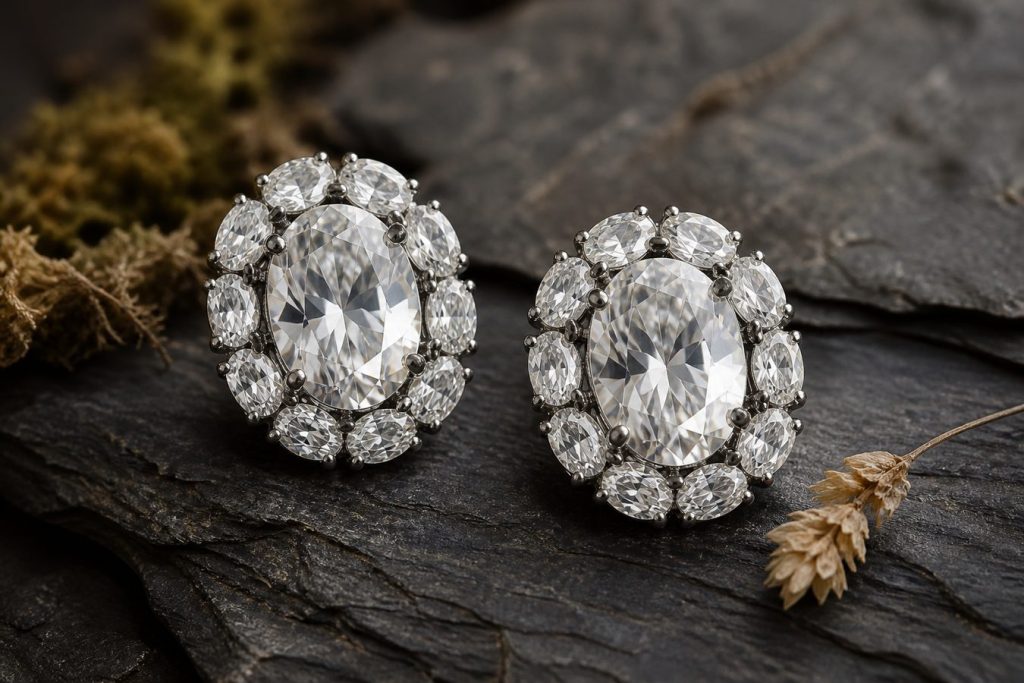
Vintage style earrings borrow silhouettes from Victorian, Art Nouveau, Art Deco, and Mid-Century design, then rework them in modern sterling silver with real natural stones. At SilverRush Style, we have been building this kind of jewelry since 2005, so this guide covers what actually separates a good vintage-look pair from a costume knockoff. You will find notes on era cues, stone facts, and fit, all written for shoppers who want the aesthetic without the estate-sale gamble.
Reading the Eras Behind Vintage Style Earrings
Victorian earrings (1837–1901) lean on filigree, seed pearls, garnet clusters, and drop shapes with wirework curls. Art Nouveau pieces (roughly 1890–1910) favor floral motifs, enamel accents, and asymmetric curves inspired by Alphonse Mucha and René Lalique.
Art Deco earrings (1920s–1930s) shift to geometry: stepped rectangles, calibré-cut stones, and marcasite set in silver. Mid-Century and Retro pieces (1940s–1960s) get bolder with cocktail clusters, chunky scrollwork, and larger center stones.
When you shop reproductions, look for the tells: milgrain edges on Edwardian styles, symmetrical fans on Deco, and openwork gallery backs on Victorian drops. A modern piece that skips these cues is usually just labeled “vintage” for search traffic.
Stones That Actually Belong in Vintage Designs
Certain gems carry era authenticity because they were mined and cut during those periods. Bohemian garnet (pyrope, Mohs 7–7.5) from the Czech region was standard in Victorian clusters, prized for a deep red that reads almost brown under candlelight.
Marcasite, chemically iron pyrite (FeS₂, Mohs 6–6.5), was pavé-set into sterling silver throughout the Deco period as a diamond substitute. Amethyst (SiO₂, Mohs 7) from Brazil and Uruguay filled Edwardian drops, while turquoise (a hydrated copper aluminum phosphate, Mohs 5–6) from Arizona and Iran anchored Southwestern revival pieces of the 1940s.
Freshwater and Akoya pearls (Mohs 2.5–4.5) appear across nearly every era, which is why a pearl-and-silver drop reads vintage across a wide date range. If you want a broader look at metal and setting options, our full sterling silver jewelry catalog groups pieces by stone so you can compare eras side by side.
Silhouettes Worth Owning
Four shapes cover most vintage wardrobes without overlap. Each one solves a different styling problem, so building a small rotation beats hunting for a single pair that does everything.
Drop and Dangle
Drop earrings sit close to the lobe with a short articulated section, usually one to two inches long. Victorian and Edwardian drops often finished with a single teardrop stone or a briolette; Deco drops added geometric spacers between the post and the terminal stone.
Chandelier
Chandelier earrings fan outward with three or more suspended elements. They photograph well because the tiers catch light from multiple angles, and they read formal without extra effort. Weight matters here: sterling silver chandeliers over three inches can tug on lobes, so check the gram weight before buying.
Stud and Cluster
Cluster studs group small stones around a center in a flower or halo layout, a format popular from the Georgian era through the 1950s. Marcasite clusters in silver are the workhorse of this category and pair with almost any neckline.
Hoop and Creole
Vintage hoops tend to be smaller than contemporary versions, often under one inch, and frequently include engraved or twisted wire detail. Creole hoops, wider at the bottom than the top, showed up in French colonial jewelry and stayed in rotation through the 1970s.
Buying Checklist Before You Add to Cart
Confirm the metal stamp first. Genuine sterling silver carries a 925 hallmark, meaning 92.5% silver alloyed with 7.5% copper or other metals for hardness.
Check the ear wire type against your needs. French hooks and lever-backs work for pierced ears; screw-backs and clip-ons remain the standard for unpierced wear and stay closest to pre-1950s originals. Posts with butterfly backs are a modern update, fine for reproductions but not period-accurate for anything before the 1930s.
Ask about stone treatment. Reputable sellers disclose whether turquoise is stabilized, whether amethyst is heat-treated, and whether pearls are cultured or freshwater. These disclosures affect price and care instructions, and they are standard practice under FTC jewelry guides.
Measure a pair you already own and compare millimeters, not adjectives. “Medium drop” means nothing across vendors, while 38mm total length is a fact you can plan around.
Care Notes for Silver and Natural Stones
Sterling silver tarnishes when sulfur in the air reacts with the surface, forming silver sulfide. A soft polishing cloth removes light tarnish; anti-tarnish strips in your jewelry box slow it down between wears.
Store pearls and turquoise separately from harder stones. Both are porous and softer than quartz-family gems, so they scratch easily and can absorb perfume or hairspray. Put earrings on last when getting ready and take them off first at night.
Marcasite is set with adhesive in many antique and reproduction pieces, so keep those earrings out of ultrasonic cleaners and hot water. A dry brush and a polishing cloth handle routine care without loosening stones.
If you want to see how these silhouettes and stones look in current production, browse the vintage-inspired sections of our sterling silver jewelry shop and filter by earring type. We stock drop, chandelier, cluster, and hoop styles year-round, and each listing spells out the stone, treatment, and measurements so you can buy with the same information a jeweler would use.