
 Shop now, pay later
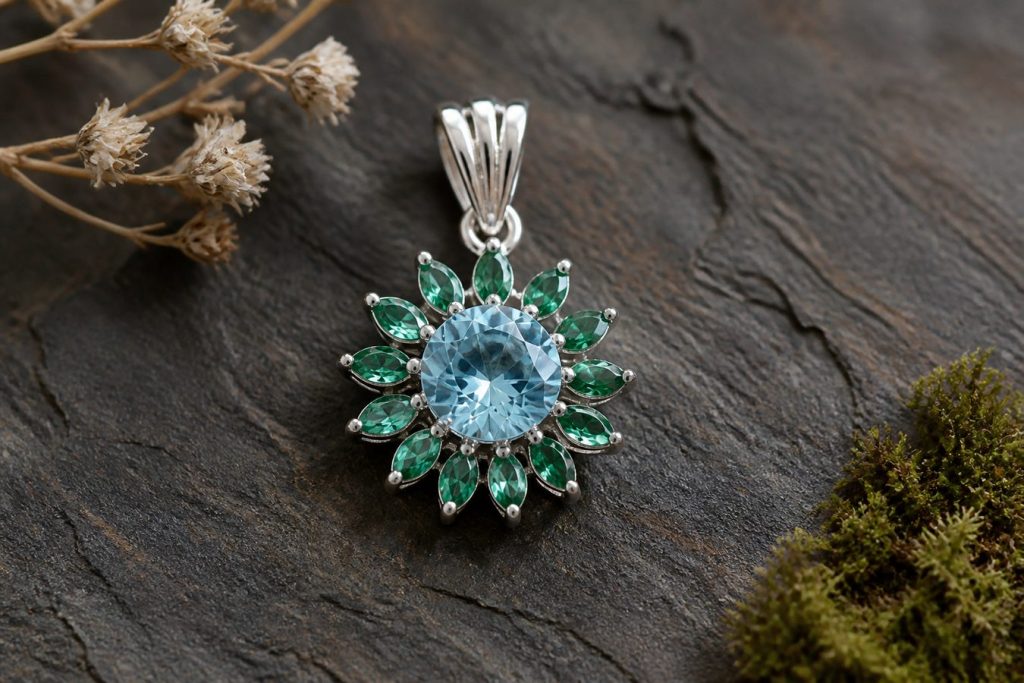
Is cubic zirconia a mineral? By the strict geological definition used by the International Mineralogical Association, no — the cubic zirconia in your jewelry is a lab-grown synthetic, not a naturally occurring mineral. The confusion is fair, though, because a natural version does exist in trace amounts, and the chemistry is identical to what comes out of a crucible in a lab.
At SilverRush Style, we’ve been setting real stones into sterling silver jewelry since 2005, so customers ask us this a lot. Here’s the straight answer, with the science and the caveats.
What Counts as a Mineral (and Why CZ Falls Short)
A mineral, in geology, must meet five criteria: it occurs naturally, is inorganic, is solid, has a defined chemical composition, and has an ordered crystal structure. Cubic zirconia is inorganic, solid, has the formula ZrO₂, and forms a cubic crystal lattice. It nails four out of five.
The one it misses is the first: naturally occurring. Nearly all CZ on the market is grown in laboratories using a process called skull melting, developed by Soviet scientists in the 1970s. That method heats zirconium dioxide powder above 2,700°C, then lets it cool into transparent crystals suitable for faceting.
So when a jeweler calls CZ a “mineral,” they’re using the word loosely to mean “a hard, crystalline stone.” Mineralogists would call it a synthetic analog of a mineral, similar to how lab-grown diamond is a synthetic analog of diamond.
The Natural Version: Baddeleyite and Rare Zirconia
Zirconium dioxide does occur in nature. The most common natural form is baddeleyite, a monoclinic mineral first identified in Sri Lanka in 1892 and later found in Russia, Brazil, and South Africa. Baddeleyite has the same chemistry as CZ but a different crystal structure at room temperature.
A rare cubic form of natural zirconia was documented in 1937, found as microscopic inclusions in metamict zircon. According to Kurt Nassau’s 1981 review in the Journal of Crystal Growth, these natural crystals were far too small and impure to cut as gems. That’s why the entire jewelry market runs on lab-grown material.
The takeaway: a natural mineral matching CZ’s chemistry and structure does exist, but you’ll never see it in a ring. Every faceted CZ in every store, ours included, was grown in a furnace.
How CZ Stacks Up Against Real Gemstones
Cubic zirconia scores 8 to 8.5 on the Mohs hardness scale, which puts it above quartz (7) and topaz (8) but below sapphire (9) and diamond (10). It’s durable enough for everyday wear in earrings, pendants, and occasional-wear rings, though the facet edges can dull over years of hard use.
Optically, CZ has a refractive index of about 2.15 and a dispersion of 0.060, which is higher than diamond’s 0.044. That extra dispersion is why CZ throws more rainbow flash than a diamond of the same cut, and it’s the easiest way for a trained eye to tell them apart under bright light.
Density is another giveaway. CZ weighs roughly 1.7 times more than a diamond of the same size, so a one-carat-look CZ actually weighs closer to 1.7 carats. If you like the sparkle of CZ set in real metal, our sterling silver collection includes plenty of options that keep the setting genuine even when the stone is synthetic.
Should You Call CZ a Gemstone, Then?
The Federal Trade Commission’s Jewelry Guides require sellers to disclose that cubic zirconia is synthetic and not to imply it’s a natural gem. Ethical retailers describe it as “cubic zirconia,” “lab-created CZ,” or “simulated diamond,” never as a mineral or a natural stone.
Some in the trade use “synthetic gemstone” for CZ, which is accurate as long as the buyer knows what synthetic means: same or similar chemistry to something in nature, but grown by people. Others prefer “diamond simulant,” which describes CZ’s role in the market without implying it shares diamond’s chemistry (it doesn’t — diamond is carbon, CZ is zirconium dioxide).
If you want a natural mineral set in silver, browse our pieces featuring turquoise, amethyst, garnet, or moonstone. If you want the look of a diamond at a fraction of the cost and you’re fine with a lab-grown stone, CZ does the job well. Both have a place in a well-built jewelry box.
Frequently Asked Questions
Is cubic zirconia the same as zircon?
No. Zircon is a natural mineral with the formula ZrSiO₄ (zirconium silicate) and has been used as a gemstone for centuries. Cubic zirconia is ZrO₂ (zirconium dioxide) and is almost always lab-grown. The names sound similar because both contain zirconium, but the stones are chemically and structurally different.
Is cubic zirconia real or fake?
CZ is a real material with a real crystal structure, so it isn’t glass or plastic. It’s not a natural mined gem, though. The accurate description is “synthetic” or “lab-created,” and reputable sellers label it as such.
Does cubic zirconia hold up in daily wear?
CZ rates 8 to 8.5 on the Mohs scale, hard enough for most jewelry. Over years of daily wear, the facet edges can soften and the surface may show scratches from harder materials like quartz dust. Rotating pieces and cleaning with mild soap extends the life of the polish.
Can a jeweler tell CZ from a diamond?
Yes, easily. A thermal or electrical conductivity tester distinguishes them in seconds, and loupe inspection reveals CZ’s higher dispersion and rounded facet junctions. Weight also gives it away, since CZ is about 70% denser than diamond.