
 Shop now, pay later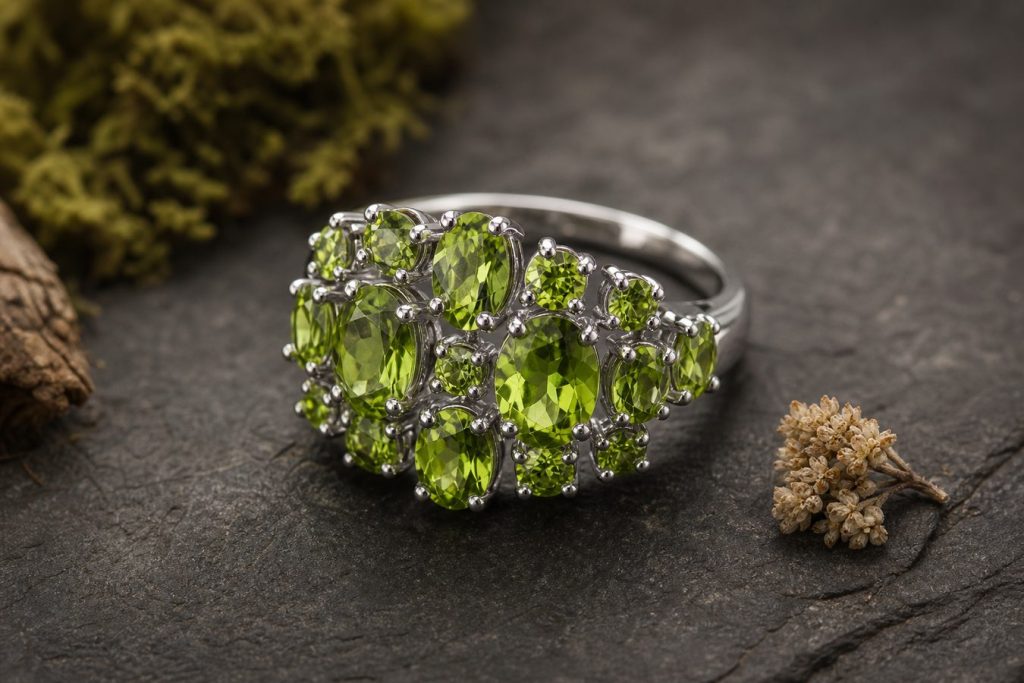
August birthstone jewelry means one thing to most collectors: peridot, the olive-green gem that has represented August births since the American National Association of Jewelers standardized the modern birthstone list in 1912. At SilverRush Style, we set natural peridot in .925 sterling silver for rings, pendants, earrings, and bracelets that suit everyday wear. This guide covers what makes peridot worth owning, where the rough comes from, and how to care for your pieces.
What Peridot Actually Is
Peridot is the gem-quality variety of the mineral olivine, with a chemical composition of (Mg,Fe)2SiO4. The iron content is what gives the stone its yellow-green to olive color, and unlike many gems, peridot is idiochromatic: the color comes from an essential element of its structure, not from trace impurities. That means every natural peridot falls within a narrow green range, from lime to deep bottle green.
On the Mohs scale, peridot registers 6.5 to 7, which puts it below quartz and well below sapphire. It handles daily wear in earrings and pendants without issue, though rings need a bit more care around hard surfaces. The stone has a distinct double refraction that gives faceted peridot a slightly doubled look at the pavilion facets when viewed under magnification.
Peridot has one of the longest documented histories of any gemstone. Ancient Egyptians mined it on Zabargad Island in the Red Sea more than 3,500 years ago, and some scholars believe several of Cleopatra’s famous emeralds were actually peridot.
Where Today’s Peridot Comes From
Most commercial peridot on the market today comes from three main sources. The San Carlos Apache Reservation in Arizona produces the majority of small to medium commercial-grade stones, typically under 3 carats, with a bright yellow-green color. Larger clean stones with deeper color usually come from Pakistan’s Kohistan region, where mines above 4,000 meters yield material discovered in the mid-1990s.
Myanmar (Burma) is the third significant source, producing stones with a rich saturated green that commands the highest prices. Smaller quantities also come from China, Vietnam, and Tanzania. Peridot is one of only two gems (along with diamond) formed deep in the Earth’s mantle rather than the crust, and rare specimens even arrive via pallasite meteorites.
When we source peridot for our sterling silver jewelry, we look for stones with even color distribution and no visible eye-level inclusions. Peridot is almost always untreated, which is unusual in the colored stone market and makes it a straightforward buy for anyone new to gemstones.
Choosing Peridot Pieces That Work
Peridot’s green pairs well with sterling silver because the cool metal tone keeps the stone’s warm yellow undertones from reading brassy. Rose gold pushes peridot toward olive, while yellow gold can wash it out in lighter stones. If you want the color to read clean and bright, silver is the practical choice.
Rings
For August birthstone rings, look for protective settings like bezels or half-bezels if you plan to wear the ring daily. Prong settings show off the stone better but expose the girdle to knocks. A 6mm to 8mm round or oval peridot works for most hand sizes without overwhelming the finger.
Pendants and Earrings
Pendants are the safest way to wear peridot since they avoid the impact that rings take. Drop earrings in the 7mm to 10mm range give enough color to read across a room, and studs in the 5mm to 6mm range work for office wear. Peridot pairs cleanly with white topaz, moonstone, and freshwater pearl accents.
Bracelets
Tennis-style bracelets with small peridot rounds show the color continuously along the wrist. For a lighter option, a single peridot charm or station on a sterling chain gives you the birthstone connection without the weight of a full line bracelet.
Caring for Peridot Jewelry
Peridot is sensitive to rapid temperature changes and acidic solutions, so skip the ultrasonic and steam cleaners that jewelers use on harder stones. Warm water with a drop of mild dish soap and a soft toothbrush cleans peridot safely. Rinse in water at the same temperature and dry with a lint-free cloth.
Store peridot pieces separately from harder gems like sapphire, topaz, and diamond, which will scratch the peridot if they rub together in a jewelry box. A soft pouch or a lined compartment does the job. Sterling silver settings will tarnish over time from air exposure, and a polishing cloth kept with your sterling silver jewelry handles most of that maintenance in a few seconds.
Remove peridot rings before gardening, cleaning with household chemicals, or working out at the gym. Chlorinated pool water and hot tubs can dull the polish over time, and lotions or perfumes should go on before the jewelry, not after.
Gifting Peridot for August Birthdays
August birthdays fall in the middle of summer, and peridot’s green suits the season better than most stones on the calendar. For milestone birthdays, a pendant or a pair of drop earrings tends to get more wear than a ring, since sizing removes the guesswork. Anniversary tradition assigns peridot to the 16th year of marriage, which gives it a second gifting occasion beyond birthdays.
If you’re shopping for someone who already owns peridot, consider a contrasting piece like a peridot and amethyst combination, or a larger statement stone if their existing pieces are all in the small-carat range. Browse our peridot selection to see current styles and stone sizes in stock.