
 Shop now, pay later
These obsidian facts cover how the stone forms, what it’s made of, and why it has held human attention for hundreds of thousands of years. Obsidian is a natural volcanic glass, not a mineral in the strict sense, because it lacks a crystal structure. That single trait shapes everything about how it looks, breaks, and gets used.
How Obsidian Forms
Obsidian forms when felsic lava from a volcano cools so fast that mineral crystals never get the chance to grow. The result is an amorphous solid, closer in structure to window glass than to granite or basalt. Geologists classify it as an igneous rock, but its glassy nature sets it apart from other volcanic products.
The chemistry is specific. Obsidian contains roughly 65 to 80 percent silica (SiO2), which puts it in the rhyolitic range, and it holds very little water, usually under one percent by weight. Small amounts of iron, magnesium, and trace elements shift its color from jet black to brown, green, or mottled snowflake patterns.
Deposits are tied to regions with recent silicic volcanism. Notable sources include Glass Buttes and Newberry Volcano in Oregon, Obsidian Cliff in Yellowstone National Park, Lipari in Italy, Armenia’s Gegham mountains, the Central Mexican Volcanic Belt, and parts of Iceland, Japan, and Kenya. Old obsidian tends to devitrify over geologic time, so most workable material is younger than about 20 million years.
Physical Properties You Can Verify
Obsidian sits at 5 to 6 on the Mohs hardness scale, similar to window glass and softer than quartz. Its specific gravity runs around 2.35 to 2.60, and it has a conchoidal fracture, meaning it breaks in smooth, curved shells rather than along flat planes. Fresh fracture edges can reach a thickness of about 3 nanometers, sharper than a surgical steel scalpel.
That edge sharpness explains why some modern surgeons have experimented with obsidian scalpel blades in research settings. It also explains why prehistoric toolmakers preferred it. The trade-off is brittleness, since the same lack of crystal structure that allows a keen edge also makes the stone prone to chipping under impact.
Color varieties have their own names. Snowflake obsidian shows white cristobalite crystallites in a black matrix. Mahogany obsidian carries iron oxide streaks, rainbow and sheen obsidian display internal reflections from nanoscale inclusions, and Apache tears are small rounded nodules weathered out of perlite. Golden and silver sheen come from aligned gas bubbles inside the glass.
Obsidian in Human History
Homo sapiens has worked obsidian for a long time. Archaeological sites in Kenya’s Rift Valley have produced obsidian tools dated to more than 300,000 years ago, and the material shows up steadily in the record from the Paleolithic onward. Neolithic communities in Anatolia at Çatalhöyük traded obsidian across hundreds of miles, and researchers now use trace-element fingerprinting to match artifacts back to specific volcanic flows.
Uses ran across the toolkit. People shaped it into spear points, arrowheads, knives, scrapers, and drills, then later into mirrors, beads, and ceremonial blades. Aztec craftsmen produced polished obsidian mirrors and the macuahuitl, a wooden club edged with obsidian blades, while Greek and Roman workshops cut it into signet stones and inlays.
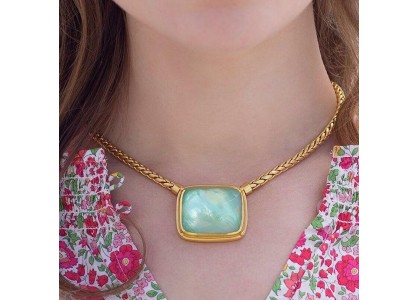
Its symbolic role has been just as steady. Many cultures associated the black glass with protection, grounding, and clear sight, likely tied to its reflective polish and volcanic origin. Those associations carry into modern lapidary work, where obsidian is cut as cabochons, beads, and faceted stones for pendants, rings, and earrings paired with sterling silver jewelry settings.
Obsidian in Jewelry Today
For jewelry, obsidian offers a deep visual finish at a reasonable price point. Cabochons of rainbow or sheen obsidian catch light in ways that faceted stones cannot, and snowflake patterns give each piece a readable structure. The stone takes a high polish because its glassy matrix has no grain to interrupt the surface.
Care is straightforward but worth spelling out. Clean obsidian with warm water, mild soap, and a soft cloth, and skip ultrasonic cleaners because internal stress fractures can propagate under vibration. Store pieces separately so harder gems like quartz, topaz, or diamond do not scratch the surface, and keep obsidian away from sharp knocks against countertops or sinks.
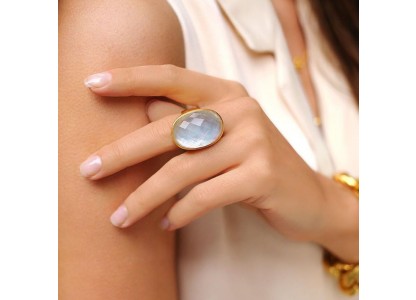
Setting choice matters with a stone this brittle. Bezel settings protect the girdle better than prong settings, and pendants tend to outlast rings because they take fewer impacts. Shoppers looking for obsidian pieces can browse our sterling silver collection for cabochon pendants, beaded strands, and cocktail rings built around the stone.
Quick Reference Facts
Type: Volcanic glass, amorphous, no crystal structure. Composition: 65 to 80 percent silica, rhyolitic chemistry, low water content. Hardness: 5 to 6 on the Mohs scale. Fracture: Conchoidal, producing edges under 3 nanometers thick.
Common colors: Black, brown, mahogany, green, snowflake, rainbow, sheen, gold sheen. Main sources: United States (Oregon, California, Wyoming, New Mexico), Mexico, Italy, Armenia, Iceland, Japan, Kenya, Ecuador. Age limit: Rarely older than 20 million years due to devitrification.
Historic uses: Cutting tools from 300,000 years ago, trade goods across Neolithic Anatolia, Aztec weapons and mirrors, Roman inlays. Modern uses: Jewelry cabochons, decorative objects, research scalpel blades, knapping practice for archaeologists.
If you want to see how obsidian looks in a finished setting, take a look at our current stock of obsidian rings and pendants and reach out with questions about specific pieces or stone origins.