
 Shop now, pay later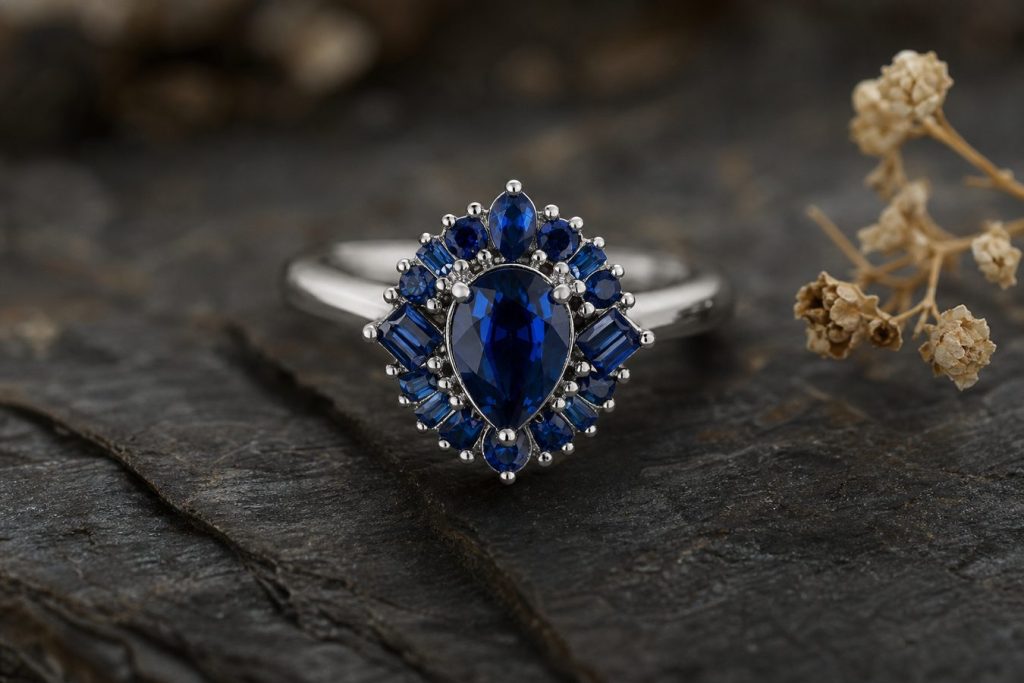
Buying a real sapphire jewelry set means checking three things at once: the stones, the metal, and the match. Sapphire is corundum (aluminum oxide, Al₂O₃) with a Mohs hardness of 9, second only to diamond, which makes it a practical choice for daily wear across rings, earrings, and pendants. This guide walks through what to verify before checkout and how to build a coordinated set that actually looks like a set.
What Makes a Sapphire Set “Real”
A natural sapphire forms in metamorphic and igneous rock, with commercial deposits mined in Sri Lanka, Madagascar, Australia, Thailand, Montana (USA), and historically Kashmir and Myanmar. Most natural sapphires on the market today have been heat-treated to improve color and clarity, which is an accepted industry practice and should be disclosed by the seller. Synthetic sapphire (Verneuil or flame-fusion, first produced commercially in 1902) has the same chemistry but is grown in a lab, so it must be labeled as created, lab-grown, or synthetic.
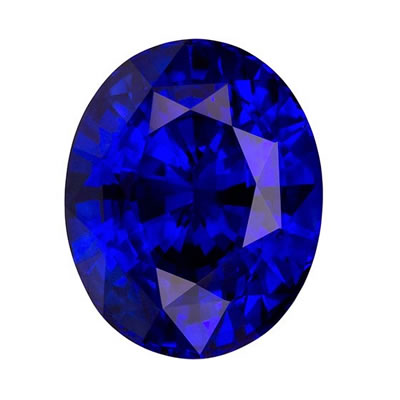
Blue is the classic hue, but corundum also occurs in pink, yellow, green, purple, and orange — the orange-pink variety is called padparadscha. Any red corundum is classified separately as ruby. When a listing says “real sapphire jewelry set,” ask whether the stones are natural or lab-grown, whether they are heat-treated, and whether the color is uniform across the ring, earrings, and pendant.
Quick verification checklist
- Ask for the treatment disclosure (heat, diffusion, glass-filled, or none).
- Confirm origin if the price reflects a premium region like Kashmir or Montana.
- Request a lab report (GIA, AGL, or Gübelin) for stones above roughly 1 carat.
- Check that all pieces in the set were color-matched, not sourced separately.
Metals: Why Sterling Silver Works for Sapphire
Sapphire pairs with gold, platinum, and silver, but sterling silver (92.5% silver, 7.5% copper) gives the blue a cooler backdrop that reads closer to the stone’s natural saturation. Sterling is also stamped .925, which is a verifiable hallmark you can check on the inside of a ring shank or the back of a pendant bail. At SilverRush Style we’ve built sterling silver jewelry around natural stones since 2005, so the settings are cut to hold cabochons and faceted sapphires without adhesive.
Prong, bezel, and halo settings each have trade-offs. Prongs show more of the stone and let light through the pavilion; bezels protect the girdle and suit active wearers; halos add carat presence around a smaller center. For a matching set, keep the setting style consistent across all three pieces — a bezel pendant with prong studs will look mismatched even if the sapphires themselves are identical.
Building a Coordinated Three-Piece Set
A standard sapphire set includes a ring, a pair of stud or drop earrings, and a pendant. To keep the look cohesive, match the shape first (round, oval, cushion, or pear), then the color grade, then the metal finish. Mixing an oval ring with round earrings works if the color and setting align, but changing all three variables at once breaks the visual link.
Carat weight should scale down from center to accent: a 1.00 ct ring center, 0.50 ct total weight earrings, and a 0.75 ct pendant is a balanced ratio. If you already own a sapphire ring and want to build outward, start with a bracelet in the same blue range — our sapphire jewelry collection uses natural stones that can be matched to existing pieces by tone and cut.
Color grading in plain terms
Sapphire color is described by hue, tone, and saturation. The trade term “cornflower blue” refers to a medium-tone, high-saturation violetish blue historically linked to Kashmir material. “Royal blue” is deeper and more saturated. Lower-cost commercial sapphires often skew toward dark, inky, or grayish blue, which reads black under indoor light.
Care, Wear, and What to Expect Long-Term
With a hardness of 9 and no cleavage, sapphire handles bathing, hand-washing, and daily bumps better than opal, emerald, or pearl. The weak point in any set is usually the metal or the setting, not the stone. Clean sterling silver sapphire pieces with warm water, mild dish soap, and a soft brush; skip ultrasonic cleaners if the stones are fracture-filled or heavily included.
Sterling silver tarnishes when exposed to sulfur in air, rubber, wool, and some cosmetics. Store each piece in a separate anti-tarnish pouch and polish with a treated cloth every few weeks. A well-made sapphire set kept this way will still look correct in 20 years, which is part of why sapphire has been used in engagement jewelry since at least the Roman era and famously in the 1981 Diana-Charles ring now worn by Catherine, Princess of Wales.
If you’re ready to compare natural sapphire sets in sterling silver, browse our current selection and message us with any stone or sizing question before you order. We’ll confirm treatment status and color match on any piece in stock.